In a 2025 survey of over 100 bank and non-bank commercial real estate lenders, four out of five debt fund respondents reported the ability to utilize some form of fund-level leverage,¹ allowing managers to generate returns in excess of the yields on the underlying loans and to better attract investors.
Although senior debt funds tout their senior loan origination strategy, they actually subordinate fund investors by borrowing loan proceeds, typically from banking institutions. Colloquially referred to as “back-leverage,” fund-level financing therefore relegates fund investors to a junior position behind repayment obligations to a third party, in contravention of the merits of senior payment priority and first-lien real estate collateral. Under these arrangements, the fund must grant a first-priority security interest in the loans it originates, or outright sell them to a banking counterparty under a repurchase facility (“repo facility”), agreeing to repurchase the collateral by repaying borrowed funds plus interest.
Back-leverage is a widely used tool across real estate debt funds and publicly traded mortgage REITs.² As investors are increasingly drawn toward the senior secured real estate lending market, fund-level financing potentially provides fund managers with the ability to generate high-yield returns on a portfolio of senior loans. While back-leverage is not inherently problematic, it introduces risks that can amplify losses that investors should understand.
The Mechanics of Back-Leverage
Under a simplified scenario of back-leverage, a senior debt fund originates a $75 million senior loan on a property but borrows $50 million at a 2:1 ratio or 67% advance rate from a banking institution. The fund borrows that $50 million at a lower interest rate than the coupon on the senior loan. The fund advances the remaining $25 million from capital raised from its investors and is the lender of record on the $75 million senior loan. The fund collects interest on the $75 million senior loan and services the debt on $50 million of borrowings, realizing the net interest margin and an enhanced, levered return on $25 million of investor capital. Senior debt funds commonly utilize 2:1 to 4:1 leverage ratios subject to varying debt financing costs based on counterparty risk, collateral quality, facility structure, mark-to-market and guaranty provisions.
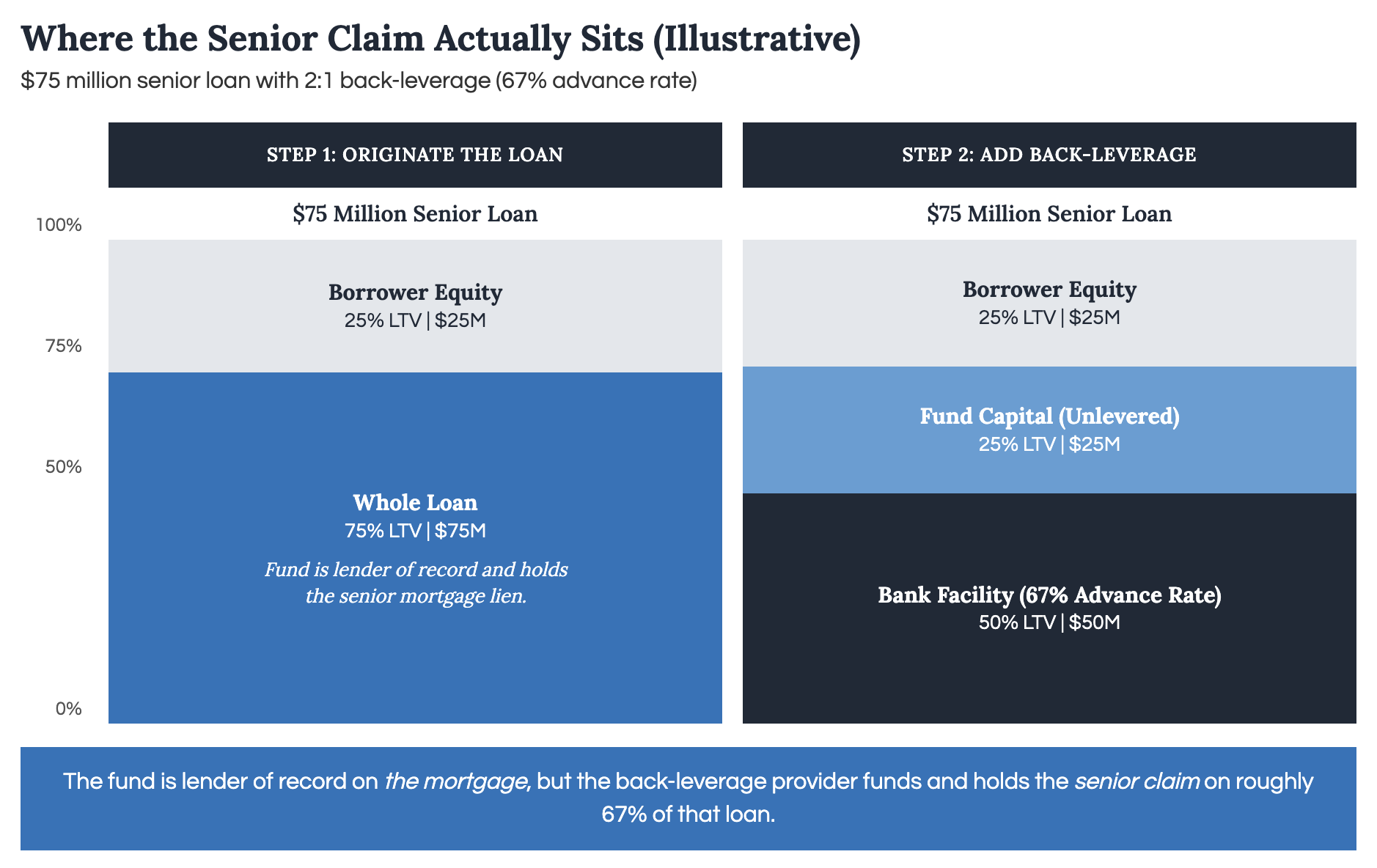
For illustrative purposes only, not indicative of every scenario.
The most common forms of fund-level leverage are warehouse facilities and repurchase facilities offered by banking institutions, which are cross-collateralized and cross-defaulted across a pool of loans originated by a fund. Under a warehouse facility, the fund grants a first-priority security interest in the loans it originates in exchange for debt proceeds up to a negotiated advance rate. Under a repo facility, the fund borrows up to a negotiated advance rate and executes an actual sale of the underlying loans to the repo counterparty under an agreement to repurchase them by paying off all amounts drawn. Both arrangements are typically full recourse, which also translates into reduced financing costs for the fund. The outright sale mechanics also make repo financing more attractive to lenders, who can extend more efficient pricing than traditional warehouse facilities, though repo is often accessible only to more established funds.
The Risks of Back-Leverage
Back-leverage may enhance investors’ levered returns, but it comes with trade-offs. The primary risk considerations include:
● Mark-to-Market & Margin Call Risk: Most repo facilities and warehouse lines require funds to post additional collateral or pay down borrowings if the market value of the pledged loans declines. This creates liquidity risk and may force a fund to sell assets or raise cash during periods of market dislocation.
● Reduced Control: A debt fund’s ability to work out a troubled loan is based on its agreement with the back-leverage provider, which dictates how long the fund has before a default forces a margin call.
● Cross-Default & Cross-Collateralization Risk: Warehouse and repo facilities contain provisions whereby a default on a single asset can trigger acceleration across the entire facility, creating a liquidity event and compounding losses to the fund.
● Refinancing / Rollover Risk: Warehouse and repo facilities are typically short-dated (1-3 years) relative to the loans they finance and present significant refinancing risk if a facility is not renewed, extended, or refinanced at maturity.
● Financial Leverage Risk: Although leverage enhances returns, it amplifies declines that would otherwise be a modest drawdown for an unlevered fund. Repo and warehouse facilities furthermore often require recourse payment guaranties from parent entities.
● Subordination Risk: Fund-level leverage sits senior to debt fund investor equity in the capital stack. In a stress scenario, leverage providers get repaid first from asset proceeds while debt fund investors absorb the first losses.
Conclusion: What Back-Leverage Can Obscure, and How PCRED Compares
The headline number in most debt fund materials is the total return. Less visible is the amount of back-leverage employed by the fund and its potential risks. A senior debt fund that utilizes back-leverage furthermore does not retain seniority in payment priority with first-lien real asset collateral. Limited partners (“LPs”) should clearly understand the subordinated position fund-level leverage creates before investing in a senior secured lending strategy.
Property-level leverage may also enhance returns while potentially reducing exposure to certain risks associated with fund-level leverage. Prospect Credit REIT, LLC (“PCRED”) originates coterminous, debt-like preferred equity investments in tandem with Freddie Mac property-level senior financing, rather than utilizing back-leverage at the fund level. This structure is designed to limit exposure to fund-level recourse, mark-to-market risk, and cross-default and cross-collateralization risk, while PCRED’s recognition by Freddie Mac allows it to exercise strong lender enforcement provisions such as change-of-control and forced-sale rights upon a borrower default.
Senior debt funds that utilize back-leverage are widespread and have grown their share of first mortgage originations by nearly 80% since 2022, from a low of 9% at the end of 2022 to 16% by the fourth quarter of 2025.³ LPs should not avoid funds that use back-leverage, but rather measure the risk-adjusted returns of senior debt funds employing fund-level leverage when reviewing real estate credit strategies.
Definitions
Advance Rate: The percentage of a loan’s value that a leverage provider will lend against when the loan is pledged or sold as collateral. For example, a 67% advance rate on a $75 million loan provides $50 million of financing.
Back-Leverage: Financing obtained at the fund level, typically from a banking institution, secured by the loans a fund originates. Also referred to as fund-level leverage, it allows a fund to lend more than its investor capital but places the leverage provider ahead of fund investors in repayment priority.
Capital Stack: The layers of capital used to finance a property or investment, ranked by repayment priority: typically senior debt, then subordinate debt or preferred equity, then common equity. Higher positions are repaid first and carry less risk.
Change-of-Control Rights: Rights that permit a lender or investor to replace the borrower’s sponsor or take control of the property-owning entity if the borrower defaults or other specified conditions are triggered.
Coterminous: A coterminous investment matures on the same date as another instrument in the capital stack, such as preferred equity whose term ends with the senior loan it sits behind, so both are repaid or refinanced together.
Cross-Collateralized: A cross-collateralized structure pledges multiple properties or loans as security for one another, so collateral backing one obligation can be used to satisfy another if the borrower defaults.
Cross-Defaulted Recourse Facilities: Credit lines, such as repurchase or warehouse facilities, in which a default on any one financed loan triggers a default across the whole facility, and the lender may pursue the borrower’s other assets beyond the pledged collateral.
Forced Sale: Right of a lender to force the borrower to sell the property if relevant loan covenants are triggered.
Full Recourse: A financing arrangement in which the lender may seek repayment from the borrower’s other assets, not only the pledged collateral, if the collateral is insufficient to repay the debt.
Government-Sponsored Enterprise (GSE): A Government-Sponsored Enterprise (GSE), Fannie Mae or Freddie Mac, supports the multifamily housing market by purchasing and securitizing apartment loans made by lenders, providing stable, low-cost capital that helps developers and owners finance, preserve, and expand the supply of multifamily housing.
Leverage Ratio: The amount of borrowed capital relative to investor equity. A 2:1 leverage ratio means $2 of borrowings for every $1 of investor capital.
Limited Partners (LPs): Investors in a private fund who contribute capital but do not participate in its management. Their liability is generally limited to the amount invested.
Margin Call: A demand by a leverage provider that the borrower post additional collateral or repay part of its borrowings, typically triggered when the value of the pledged assets declines.
Mark-to-Market: The periodic revaluation of an asset to its current market value rather than its original cost. Under leverage facilities, a decline in the lender’s mark can trigger a margin call.
Net Interest Margin: The difference between the interest a fund earns on its loans and the interest it pays on its borrowings.
Preferred Equity: Preferred equity is a form of financing that sits between senior debt and common equity in the capital stack that provides capital to a project in exchange for a fixed or priority return, with repayment rights that are subordinate to the lender’s but senior to the sponsor’s ownership, often including certain control rights if the borrower underperforms.
REIT: A REIT (real estate investment trust) is a company that owns, operates, or finances income-producing real estate across various sectors. Structured to avoid corporate income tax, REITs must distribute at least 90% of their taxable income to shareholders as dividends.
Repurchase Facility (Repo Facility): A financing arrangement in which a fund sells loans to a counterparty, typically a bank, and agrees to repurchase them at a later date by repaying the amount borrowed plus interest.
Risk-Adjusted Return: A measure of an investment’s return relative to the amount of risk taken to achieve it, used to compare strategies with different risk profiles.
Senior Loan: A loan that holds first priority for repayment and is secured by a first lien on the property, so it is repaid before any subordinate debt or equity.
Warehouse Facility: A revolving credit line, typically provided by a bank, that a lender uses to fund loans, with the originated loans pledged as collateral up to a negotiated advance rate.
Sources
1. Knight Frank Capital Advisory, “Behind the Stack: The Rise of Back Leverage in Commercial Real Estate Debt,” February 2025.
2. PGIM Real Estate, “The Strategic Use of Leverage in Real Estate Debt Funds,” January 2024.
3. MSCI Real Capital Analytics, “US Capital Trends: US Big Picture, Lender Edition,” February 2026 (data as of March 24, 2026).
Disclosures
This material is educational in nature and does not constitute an offer to sell or the solicitation of an offer to buy any securities. All statements, assumptions and opinions included in this material are based upon current market conditions as of the date of the material and are subject to change. This material does not purport to be all-inclusive or otherwise contain all of the information that a prospective investor may need or desire concerning an investment. Prospective investors should read the Confidential Private Placement Memorandum of PCRED in its entirety before making a decision to invest. Investment in PCRED is for Accredited Investors only. There is no guarantee that PCRED’s objectives will be met or that PCRED will qualify as a REIT. NEITHER THE SEC NOR ANY STATE SECURITIES COMMISSION HAS APPROVED OR DISAPPROVED OF ANY OFFERING AND ANY REPRESENTATION TO THE CONTRARY IS A CRIMINAL OFFENSE.
All investments involve risk, including the risk of loss of all or a portion of the invested amount. Any investment is subject to a variety of risks and there can be no assurance that any investment will meet its investment objectives, if any, or that investors will not incur losses.
Neither PCRED nor Prospect is adopting, making a recommendation for or endorsing any investment strategy or particular security. All opinions are subject to change without notice, and you should always obtain current information and perform due diligence before participating in any investment. All investing is subject to risk, including the possible loss of principal. Prospect cannot guarantee that the information herein is accurate, complete or timely. We make no representation or warranty in respect of any information derived from the third-party sources which has not been independently verified.
Investing in the Fund during a private placement is speculative and involves a high degree of risk, including the risk that you may receive little or no return on your investment or that you may lose part or all of your investment. A private placement has a relative lack of liquidity and is suitable only for persons of substantial financial means who have no need for liquidity. There can be no assurance that PCRED’s investment objectives will be met. An investor should carefully consider the fees and expenses, and other information found in the PPM, including the “Risk Factors” section, before making an investment decision.
This investment is for Accredited Investors only and a PPM can be provided to those Accredited Investors upon request. The Internal Revenue Code of 1986, as amended, imposes numerous constraints on the operations of REITs that do not apply to other investment vehicles. Failure to comply with certain constraints could have a material adverse impact on the Fund. For example, if we fail to qualify as a REIT and no relief provisions apply, our NAV and cash available for distribution to our stockholders could materially decrease. Many competitors are not subject to the operating constraints associated with REIT compliance.
A number of factors may prevent each of the Fund’s investments from generating sufficient net cash flow or may adversely affect their value, or both. These factors include, but are not limited to, national economic conditions, regional and local economic conditions (which may be adversely impacted by plant closings, business layoffs, industry slow-downs, weather conditions, natural disasters, and other factors), local real estate conditions (such as over-supply of or insufficient demand), changing demographics, perceptions by prospective tenants of the convenience, services, safety, and attractiveness of a property, the ability of property managers to provide capable management and adequate maintenance, the quality of a property’s construction and design, increases in costs of maintenance, insurance, and operations (including energy costs and real estate taxes), changes in applicable laws or regulations (including tax laws, zoning laws, or building codes), potential environmental and other legal liabilities, potential instability, default or bankruptcy of tenants in the properties owned by PCRED, and the relative illiquidity of real estate investments in general.
PCRED has a limited operating history.
Ultimus Fund Distributors (Member FINRA/SIPC) is the Distributor for Prospect Credit REIT, LLC.