How We Got Here
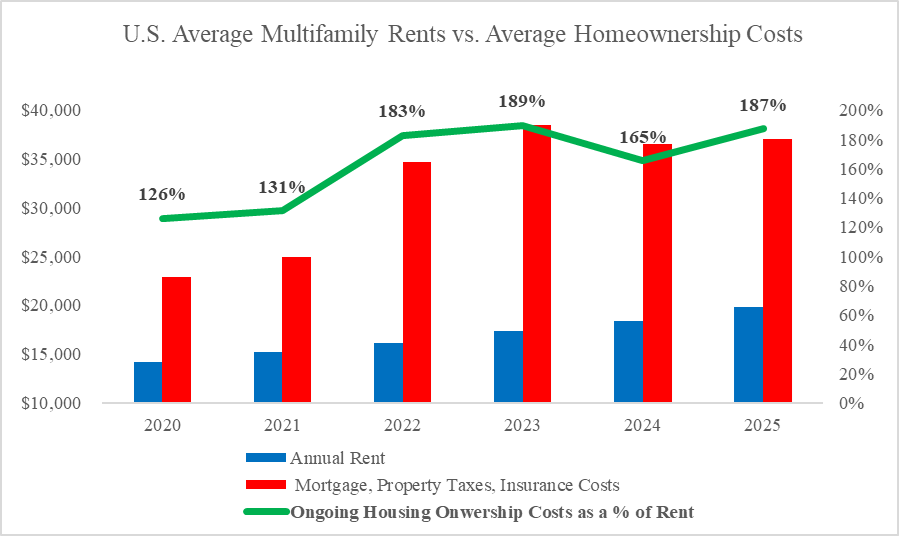
Since 2020, for-sale housing prices have increased by 58%, outpacing the 30% growth in household earnings.(5) Over the same period, average mortgage rates climbed from 3.7% to roughly 6.7%.(2) Between 2020 and 2024, total ongoing homeownership costs, including mortgage payments, taxes, insurance, and maintenance, rose by 50.6%,(1,2,6) while wages increased by only 25.8%,(5) lagging behind the rising monthly expenses for homeowners. Additionally, the ongoing costs of owning a home have become 1.6 times more expensive than renting, up from 1.3 times more expensive in 2020, making homeownership increasingly unaffordable.(1,2,3,4)
In addition to higher ongoing costs for homeowners, the homeownership affordability issue is being exacerbated by insufficient supply of for-sale housing. For-sale housing supply grew by only 19% between 2000 and 2020, while demand grew by 26%. Freddie Mac estimated that over that period the for-sale housing shortage grew to 3.8 million homes.(2) In 2024, new for-sale housing construction plummeted to a five-year low, suggesting that the ongoing mismatch between supply and demand will persist.(7)
Current Landscape
Today, elevated interest rates, muted wage growth, and lack of affordable new supply remain persistent headwinds for for-sale housing affordability. As shown below, significant adjustments to these conditions are required to return to pre-2020 levels of affordability.
- Current mortgage rates at 6.4%,(2) need to fall to 2.1% for housing affordability to return to pre-2020 levels.(8)
- Household incomes need to rise by 69.0% for housing to return to pre-pandemic levels of affordability.(8) Since 2012, nominal wages have only climbed an average of 4.4% annually.(5)
- 3.8 million new for-sale homes are required to eliminate the supply-demand gap.(9) Based on 2024 levels of new housing construction relative to household formation, the South would satisfy its housing supply gap of 1.2 million homes in three years, the West would require 6.5 years, the Midwest would need 41 years, and the Northeast would never close the gap.(9)
Looking ahead:
Fueled by these trends, economists estimate renter households to grow 17% between 2024 and 2040.(10) Over that same period, homeownership is expected to decline from 65% to 62%.(10) In our opinion, the continued decline in homeownership will benefit multifamily investors, especially in the Midwest and Northeast, where renting is currently 54% and 34% more affordable than purchasing a home,(9) respectively, and the supply of new homes is muted compared to markets in the South, where for-sale construction starts have been more prominent.
Prospect Credit REIT, LLC (“PCRED”), a non-traded real estate fund focused on real estate credit and managed by an affiliate of Prospect Capital Management, L.P. (“Prospect”), concentrates on lending in the multifamily sector, which is potentially poised to benefit from a continued long run demand for rental housing.
For more information, contact PCRED Investor Services at: investorservices@pcredreit.com
Footnotes: (1) iPropertymanagement | (2) Freddie Mac | (3) ATTOM | (4) Federal Reserve Bank of St. Louis | (5) Federal Reserve, U.S. Bureau of Labor Statistics, U.S. Federal Housing Finance Agency, and U.S. Bureau of Economic Analysis | (6) Bankrate | (7) US Census | (8) Bloomberg, Haver, CoreLogic, MLS, Morgan Stanley Research | (9) Realtor.com | (10) Urban Institute: The Future of Headship & Homeownership
Disclosures
This material is educational in nature and does not constitute an offer to sell or the solicitation of an offer to buy any securities. All statements, assumptions and opinions included in this material are based upon current market conditions as of the date of the material and are subject to change. This material does not purport to be all-inclusive or otherwise contain all of the information that a prospective investor may need or desire concerning an investment. Prospective investors should read the Confidential Private Placement Memorandum of PCRED in its entirety before making a decision to invest. Investment in PCRED is for Accredited Investors only. There is no guarantee that PCRED’s objectives will be met or that PCRED will qualify as a REIT. NEITHER THE SEC NOR ANY STATE SECURITIES COMMISSION HAS APPROVED OR DISAPPROVED OF ANY OFFERING AND ANY REPRESENTATION TO THE CONTRARY IS A CRIMINAL OFFENSE.
Neither PCRED nor Prospect is adopting, making a recommendation for or endorsing any investment strategy or particular security. All opinions are subject to change without notice, and you should always obtain current information and perform due diligence before participating in any investment. All investing is subject to risk, including the possible loss of principal. Prospect cannot guarantee that the information herein is accurate, complete or timely. We make no representation or warranty in respect of any information derived from the third-party sources which has not been independently verified.
Investing in the Fund during a private placement is speculative and involves a high degree of risk, including the risk that you may receive little or no return on your investment or that you may lose part or all of your investment. A private placement has a relative lack of liquidity and is suitable only for persons of substantial financial means who have no need for liquidity. There can be no assurance that PCRED’s investment objectives will be met. An investor should carefully consider the fees and expenses, and other information found in the PPM, including the “Risk Factors” section, before making an investment decision.
Ultimus Fund Distributors (Member FINRA/SIPC) is the Dealer Manager for Prospect Credit REIT, LLC.